Berlim panoramic view — Alemanha

Voyspark · Destinations · Alemanha

Berlim.
The city that reinvents itself on every corner.

Free
7 bairrosHistória a céu abertoTechno + memóriaMulticultural radical

📊 Quick comparison

ItemValue
Best seasonmaio, junho, julho, agosto, setembro
LanguageAlemão (inglês difundido, especialmente em Mitte/Kreuzberg)
CurrencyEuro (EUR)
Power plugTipo F (Schuko) · 230V · 50Hz
Emergency112 (geral europeu) · 110 (polícia)
Avg cost/day (couple)€ 343 /day (couple)
Direct flightsSão Paulo (GRU) ⇄ Frankfurt (FRA) by LATAM/Lufthansa with 1h connection to Berlin, total ~14 hours, US$ 900-1,400 high season, US$ 650-1,000 low season.
Vaccines / docsBerlin is part of the Schengen Area, allowing visa-free entry of up to 90 days in any 180-day period for nationals of over 60 countries, including Brazil, United States, Canada, Mexico, Argentina, Chi

Berlin is not a city you understand. It is a city you cross in layers, like reading a book written by dozens of authors who never spoke to each other. Each neighborhood carries a different version of Germany — and none of them is in a hurry to explain itself.

Here time is honest: war left marks no one hid, the Wall became an open-air museum, and every bronze plaque on the ground remembers someone who lived in that building before 1942. Berlin treats memory as infrastructure — not decoration.

At night the city becomes something else. Not the neon night of guidebooks, but the long, political, never-rushed night — clubs that open Friday and close Monday, conversations in German and Arabic and Turkish and English at the same table, and the certainty that nobody here came to impress anyone.

Berlin rewards those who walk. Distances fool you on the map — this city is nine times larger than Paris in area. But within each Kiez (microneighborhood) you walk for hours and find Turkish bakeries, trilingual bookshops, parks where Germans read in silence while children play unsupervised.

The city is cheap by Western European standards — and that is part of its identity. Rent still lower than Paris, excellent dinner for 15 euros, beer for 4 in any bar. But what makes Berlin Berlin is not the price. It is being a city still being written, in real time, with people from all over the world holding the pen.

Voyspark editorial · updated monthly by our resident editor in Berlim.

By the numbers.

Population

3,7 milhões (área metropolitana 6,1 milhões)

Time zone

CET / CEST (UTC+1 / UTC+2 no verão)

Language

Alemão (inglês difundido, especialmente em Mitte/Kreuzberg)

Currency

Euro (EUR)

Plug · voltage

Tipo F (Schuko) · 230V · 50Hz

Emergency

112 (geral europeu) · 110 (polícia)

Known for

Muro de BerlimTechno e BerghainCurrywurst e dönerMuseum IslandBrandenburg GateReichstagEast Side GalleryMulticulturalismo turco-árabe

History.

From medieval village to capital of five regimes in 800 years

Berlin first appears in documents in 1237, as a small trading post on the banks of the Spree river, founded by merchants who traded fish and grain between Poland and Saxony. Together with the twin village of Cölln (across the river), they formed a pair of modest Hanseatic cities, with nothing foreshadowing the imperial destiny they would have. For 400 years, Berlin was a medium-sized European city — fortified, commercial, with population oscillating between 6 and 12 thousand inhabitants.

The turning point comes in 1701, when Berlin becomes capital of the Kingdom of Prussia under Frederick I. Frederick the Great (reigned 1740-1786) transforms the city into a center of power and Enlightenment culture: builds Sanssouci Palace in Potsdam (30 minutes away), hosts Voltaire, founds academies, expands the Prussian army into Europe's most respected. Berlin grows from 60,000 to 170,000 inhabitants. The Unter den Linden boulevard — today the main tourist artery — is designed in this period as a monumental avenue connecting the Royal Palace to Tiergarten.

The 19th century is the century of German industrialization and nationalism. In 1871, under the leadership of Chancellor Otto von Bismarck and the Prussian victory over France, Berlin becomes the capital of the newly unified German Empire. The city becomes an industrial metropolis at vertiginous scale: population jumps from 800,000 in 1870 to 4 million in 1920, matching London and New York. Iconic constructions arise: the Reichstag (1894), Berliner Dom (1905), the first U-Bahn line opened in 1902. Berlin becomes a world scientific center — Einstein lectures at Humboldt University, and the city hosts 13 Nobel laureates between 1900 and 1933.

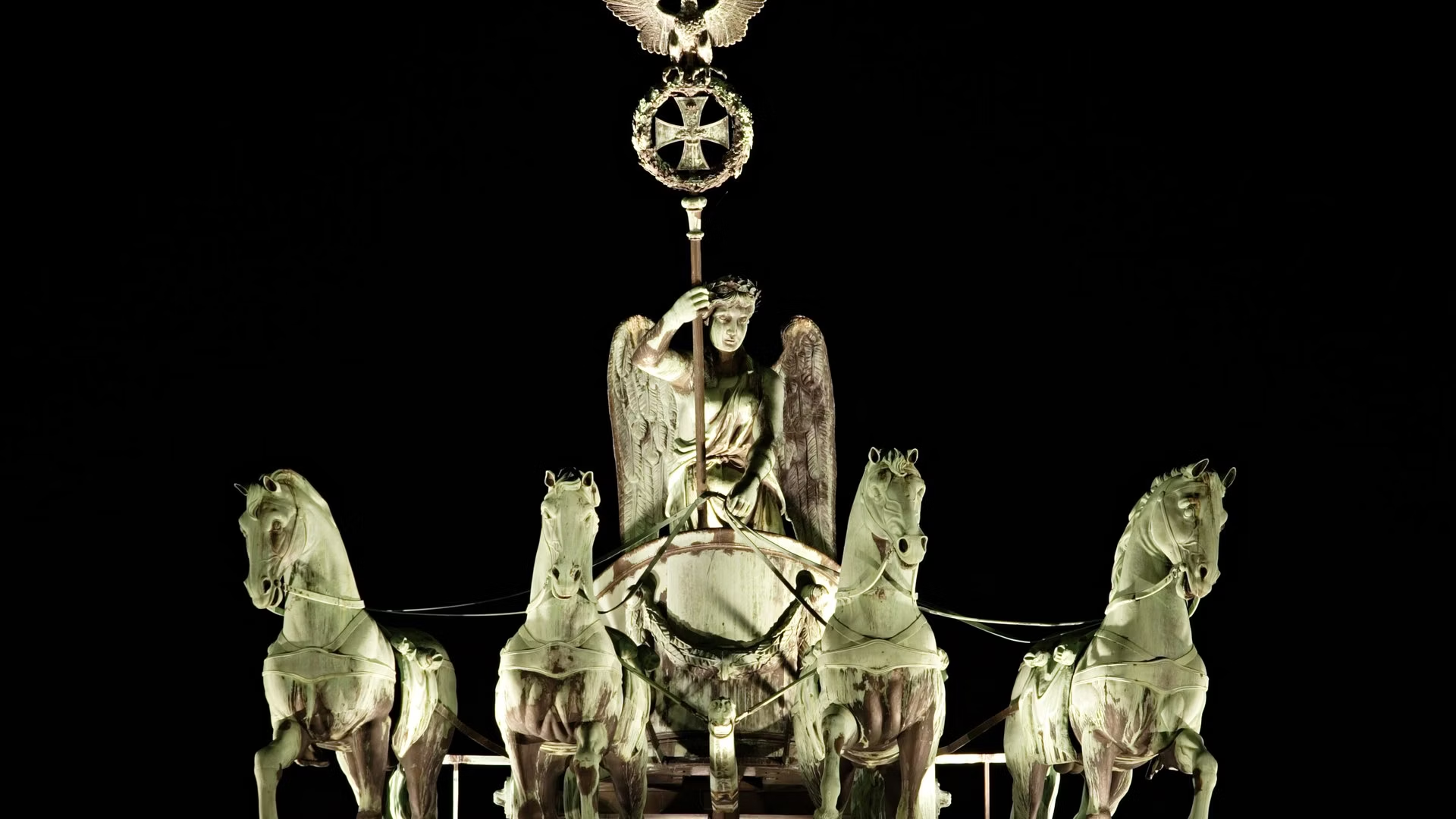
Portão de Brandemburgo — símbolo da cidade reunificada
Portão de Brandemburgo — símbolo da cidade reunificada. · Wikimedia Commons · CC BY-SA 2.5

The Weimar Republic (1918-1933), proclaimed after Germany's defeat in World War I, transforms Berlin into the most audacious cultural laboratory of the 20th century. The 1920s city is Marlene Dietrich, Bertolt Brecht, the Bauhaus, Anita Berber's cabaret, the first organized LGBTQIA+ movements in history (Magnus Hirschfeld's Institute of Sexology, founded in 1919), the expressionist painters, Fritz Lang's cinema, and Erwin Piscator's political theater. Berlin was simultaneously the freest and most decadent city in Europe — and the tension between those two Berlins is the backdrop of films like "Cabaret" and the series "Babylon Berlin".

Nazism comes to power in January 1933 and, in a few months, ends this period. Hitler chooses Berlin as the Third Reich capital and commissions Albert Speer with a monumental remodeling plan that would rename the city "Germania." The 1936 Olympic Games are held here — Nazi propaganda on a global scale. The Kristallnacht of November 9-10, 1938 marks the organized beginning of persecution of Berlin Jews, who were 160,000 in 1933 and 55,000 of whom were murdered in the Holocaust. The Wannsee Conference, held in January 1942 in a villa in the city's west, planned the "Final Solution." The bunker where Hitler committed suicide on April 30, 1945 was under Wilhelmstraße — today the area is just a parking lot, with no plaque, a deliberate German government decision to avoid creating a pilgrimage site.

World War II leaves Berlin in ruins: 80% of the city center destroyed, 600,000 uninhabitable homes, 70 million cubic meters of rubble. In 1945, the Allies divide the city into four sectors (American, British, French, Soviet). In 1949, with the Cold War, two Germanys emerge: East Berlin becomes the capital of the GDR (German Democratic Republic, communist) and West Berlin becomes an isolated enclave in the middle of communist territory, sustained by the 1948-49 Airlift. In the dawn of August 13, 1961, without warning, the GDR government closes the border between the two Berlins with barbed wire and, in the following months, builds the Berlin Wall: 155 km of concrete, 302 watchtowers, 20 bunkers, mined sand strip — to prevent East citizens from fleeing west. 140 people died trying to cross between 1961 and 1989.

The fall of the Wall on November 9, 1989 is one of the most documented events of the 20th century — crowds with hammers, tears, Trabants crossing Checkpoint Charlie, Mstislav Rostropovich playing Bach before the ruins. German reunification is formalized on October 3, 1990 (today a national holiday). Berlin returns as capital in 1991, and in the following decades receives massive investment to rebuild the east, integrate the two halves, and become the political-cultural center of the new Europe. Potsdamer Platz, completely empty at the end of the 1980s (in the Wall's dead zone), is reoccupied with contemporary architecture by Renzo Piano and Helmut Jahn during the 1990s.

The Berlin of 2026 is a city that keeps reinventing itself. After decades of cheap rent and attracting artists, writers, musicians and startups from around the world (Berlin became Europe's "startup capital" in the 2010s), the city now faces the tension of gentrification: rents rose 80% in the last 10 years, historical immigrant populations are pushed out of central neighborhoods, and popular referendums try to regulate the real estate market. At the same time, Berlin welcomed 100,000 Ukrainians after 2022, maintained the largest Turkish diaspora outside Turkey, and remains the European city where more languages are spoken per square meter. The Brandenburg Gate, which was a symbol of division until 1989, is today a symbol of unified Europe — and the stage for every collective celebration in the city, from New Year to Pride.

Neighborhoods by personality.

Every neighborhood has its own temperature. Tell us your vibe — we'll re-rank.

01

Kreuzberg

95% match with your Slow Romantic profile

The most German-Turkish neighborhood in the world. Döner kebab was invented here, the largest Turkish diaspora outside Turkey lives here, and 80s counterculture never fully left. Bergmannstraße is a corridor of cafes, bookshops and Middle Eastern bakeries. Görlitzer Park on Sunday is the Berlin nobody warned you about: families, music, BBQ, all languages. District of Berghain (SO36 side) and the largest street art scene in Europe.

✓ Comida turca/árabe excepcional✓ Vida noturna lendária⚠ Pode ser intenso à noite

02

Mitte

88% match with your Slow Romantic profile

The historic core — Brandenburg Gate, Reichstag, Museum Island, Unter den Linden. It is the Berlin postcard with reason. Staying in Mitte means walking to icons without metro. But Mitte has two sides: the official-tourist and Mitte-North (Rosenthaler Platz, Torstraße) — art galleries, specialty cafes, Berlin designer boutiques. Expensive by city standards, but value-for-money on a first trip.

✓ Tudo a pé✓ Pontos icônicos⚠ Mais caro que outros bairros

03

Neukölln

91% match with your Slow Romantic profile

The neighborhood that was working-class immigrant and became hipster epicenter in the 2010s. Today it lives in creative tension: 40-year-old Arab families next to ceramic studios and natural wine bars. Schillerkiez (north) is where the creative scene bloomed. Sonnenallee is Europe's densest "Arab street" — Syrian, Palestinian, Lebanese restaurants open until 2 AM. Walking from here to Tempelhofer Feld in 20 minutes is the best intro to everyday Berlin.

✓ Comida do Oriente Médio top tier✓ Energia criativa real⚠ Lado sul ainda em transformação

04

Prenzlauer Berg

84% match with your Slow Romantic profile

Restored East Berlin. Altbau buildings (19th century) impeccably renovated, wide tree-lined streets, organic market on Saturdays at Kollwitzplatz. The neighborhood has fame as "embassy of young German families" — many strollers, well-behaved dogs, vegan cafes. For those seeking charming and quiet Berlin, it is the obvious choice. Mauerpark on Sunday (karaoke + flea market) is a city institution.

✓ Arquitetura preservada✓ Tranquilo e familiar⚠ Menos noturno

05

Friedrichshain

87% match with your Slow Romantic profile

The neighborhood of Berghain, Boxhagener Platz, most of East Side Gallery. Friedrichshain has younger and more political energy than Prenzlauer Berg — where students and artists in their 20s-30s can still pay rent. Simon-Dach-Straße has a bar every 5 meters. Boxhagener Platz becomes flea market on Sundays. Crossing Oberbaumbrücke to Kreuzberg is one of the city's most beautiful walks.

✓ Vida noturna densa✓ East Side Gallery a pé⚠ Ruas mais bagunçadas

06

Charlottenburg

72% match with your Slow Romantic profile

Classic West Berlin — Kurfürstendamm, KaDeWe (largest department store in continental Europe), Charlottenburg Palace. The neighborhood was the heart of West Berlin during the Cold War and retains that bourgeois elegance: luxury shops, formal restaurants, large hotels. Less "alternative Berlin" and more "prosperous Germany." Good choice for business travel or those who prefer comfort over edge.

✓ Hotelaria de alto padrão✓ Shopping de luxo⚠ Pouco "berlinense"

07

Wedding

78% match with your Slow Romantic profile

The next Neukölln, according to every newspaper for 10 years. Wedding is still genuinely working-class — huge Turkish markets on Müllerstraße, African cafes, art spaces occupying old factories. Cheap lodging, neighborhood with working Berlin face. Not the place for immediate charm. The place for understanding how the city transforms.

✓ Preços baixos✓ Berlim real, sem filtro⚠ Charme exige tempo

When to go.

We crossed climate, average price, crowds and your tastes. Green = good, gold = great, red = avoid.

Jan ·
Fev ·
Mar · €€
Abr13° · €€
Mai18° · €€€
Jun21° · €€€
Jul23° · €€€€
Ago23° · €€€€
Set18° · €€€
Out12° · €€
Nov · €€
Dez · €€€

Voyspark AI suggests: Maio a setembro é a janela de ouro — biergartens abertos, parques cheios, dias longos (até 22h em junho). Julho/agosto puxa preço por causa de festivais. Dezembro vale só se você quer mercado de natal (Gendarmenmarkt é o melhor). Janeiro-fevereiro é cinza pesado, melhor evitar.

Gastronomy.

Dishes worth the trip — no tourist traps, no gimmicks.

Currywurst — clássico de rua berlinense

Currywurst

Berlin's sausage, served sliced with curry-flavored tomato sauce, accompanied by fries or bread. Invented in 1949 by Herta Heuwer at a Charlottenburg street stand, it is the most democratic snack in the city — eaten by executives, workers, tourists and drunks at 3 AM. Every Berliner has a favorite stand.

📍 Curry 36 (Mehringdamm 36, Kreuzberg) ou Konnopke's Imbiß (Schönhauser Allee, Prenzlauer Berg)💶 € 4-6

Wikimedia Commons · CC BY-SA 3.0

Döner kebab — invenção turco-berlinense dos anos 70

Döner kebab

The most famous Turkish sandwich in the world was effectively invented in Berlin in 1972 by Kadir Nurman, a Turkish immigrant who adapted the traditional döner (served on a plate) into a practical sandwich format. Today there are over 1,500 döner restaurants in Berlin. Classic version: lamb or chicken cut from the vertical spit, pita bread, salad, sauces.

📍 Mustafa's Gemüse Kebap (Mehringdamm) — fila famosa mas vale, ou Rüyam (Sonnenallee, Neukölln)💶 € 6-9

Wikimedia Commons · CC BY 2.0

Schnitzel — bife empanado classico

Schnitzel Wiener Art

Classic breaded cutlet — traditionally veal (original Wiener Schnitzel) or pork (most common version in Berlin). Comes with parsley-sautéed potato, green salad, lemon slice. Heavy lunch dish, perfect on a cold day. Not exclusive to Berlin but the city does excellent versions in traditional houses.

📍 Zur Letzten Instanz (mais antigo restaurante de Berlim, 1621, Mitte) ou Renger-Patzsch (Schöneberg)💶 € 16-24

Wikimedia Commons

Eisbein — joelho de porco com chucrute

Eisbein

Slow-cooked pork knuckle, served with sauerkraut, yellow pea puree and mustard. Typical Berlin dish (in Munich it is served grilled, called Schweinshaxe). Voluminous, salty, definitive: one portion feeds two people. Traditional brewery specialty.

📍 Max und Moritz (Oranienstraße, Kreuzberg) ou Marjellchen (Charlottenburg, cozinha da Prússia Oriental)💶 € 18-26

Wikimedia Commons

Kartoffelpuffer — panqueca de batata alema

Kartoffelpuffer

Fried potato pancake, crispy outside and soft inside, served with applesauce (sweet version) or sour cream with chives (savory version). Fair food, common at Christmas markets and street parties. Pairs well with grilled sausage.

📍 Markthalle Neun (mercado coberto, Kreuzberg) — Street Food Thursdays💶 € 4-7

Wikimedia Commons

Bratwurst grelhada com pao e mostarda

Bratwurst grelhada

Grilled sausage in bread, served with sweet or spicy mustard. There are dozens of regional variations (Thüringer, Nürnberger, Bockwurst) and every brewery has its recipe. In Berlin, found at any street stand, Christmas market, or biergarten.

📍 Bratwurst Express (Bahnhof Friedrichstraße) — clássico💶 € 3-5

Wikimedia Commons

Berliner Pfannkuchen — donut alemao recheado

Berliner Pfannkuchen

The German donut — fried doughnut filled with raspberry jam and dusted with powdered sugar. In Berlin called simply "Pfannkuchen" (in the rest of Germany called "Berliner"). Eaten for breakfast, on New Year's Eve (tradition), or as an afternoon snack.

📍 Bäckerei Siebert (várias unidades) ou Aida (cadeia austríaca, qualidade boa)💶 € 1,50-3

Wikimedia Commons

Brezel — pao torcido alemao

Brezel (pretzel)

The twisted German bread, with dark hard crust and soft interior, sprinkled with coarse salt. Can be eaten plain, with butter, or split in half with ham and cheese. Classic beer accompaniment at biergartens. Small versions (Mini-Brezel) are school snacks.

📍 Qualquer Bäckerei tradicional (padaria) — Brezel Bar na Hackescher Markt para versões criativas💶 € 1-3

Wikimedia Commons

Gözleme turca em Berlin

Gözleme turca

Thin Turkish dough stuffed with white cheese and spinach, potato, or seasoned ground meat — baked on a hot griddle in front of the customer. Specialty of Berlin's Turkish markets (Türkischer Markt at Maybachufer, Thursdays and Sundays). Authentic street food, made by Turkish women for decades.

📍 Türkischer Markt am Maybachufer (Kreuzberg/Neukölln) — quintas e domingos💶 € 5-8

Wikimedia Commons · CC

Pho vietnamita em Berlin

Pho vietnamita

Vietnamese rice noodle soup with beef broth, fresh herbs, bean sprouts and lime. Berlin has the largest Vietnamese scene in Europe — heritage of Vietnamese worker migration to East Berlin in the 1980s, who stayed after the Wall fell. Neighborhoods with strong presence: Prenzlauer Berg (Helmholtzplatz), Mitte (Rosenthaler Straße).

📍 Monsieur Vuong (Mitte) — clássico desde 1999, ou District Mot (várias unidades)💶 € 10-14

Wikimedia Commons · CC

Weisswurst — salsicha branca bavara

Weisswurst

The Bavarian white sausage — made of veal and bacon, cooked in hot water, served with sweet mustard, Brezel and wheat beer. Not traditionally from Berlin (comes from Munich) but popularized in the city. Traditionally eaten before noon, a habit maintained in Bavarian houses in Berlin.

📍 Hofbräu Berlin (Mitte) — replica grande do Hofbräuhaus de Munique💶 € 8-12

Wikimedia Commons

Cerveja Dunkel — escura alema tradicional

Cerveja Dunkel

Traditional dark beer, caramel color, malty flavor, less bitter than stout. Berlin has resurging craft breweries (BRLO, Schoppe Bräu, Vagabund) but also keeps classics like Berliner Pilsner and Berliner Kindl. At a summer biergarten, the obvious order.

📍 BRLO Brwhouse (Kreuzberg, próximo ao Tempelhofer Feld) — cervejaria + biergarten💶 € 4-6 (caneca de 500ml)

Wikimedia Commons

Hefeweizen — cerveja de trigo turva

Hefeweizen

Unfiltered wheat beer, cloudy, with banana and clove aroma, tall creamy foam. Served in characteristic tall glass. Pairs well with grilled food (bratwurst, weisswurst). The summer beer par excellence — refreshing, alcoholic but light.

📍 Prater Garten (Prenzlauer Berg, biergarten mais antigo de Berlim, 1837)💶 € 4-5,50

Wikimedia Commons

Falafel sufi em Berlin

Falafel sufi

Fried chickpea balls with spices, served in Syrian bread with tahini, salad, pickles and harissa. Berlin's Arab scene — fueled by the post-2015 Syrian diaspora and historical Lebanese community — made Berlin one of the world's best cities to eat falafel outside the Middle East. Vegan, generous, cheap versions.

📍 Azzam (Sonnenallee, Neukölln) — institucional na cena síria, ou Habibi (cadeia local confiável)💶 € 5-8

Wikimedia Commons · CC

Getting there and around.

Airport, public transport, direct flights, walkability.

From airport to center

BER airport (Berlin Brandenburg, opened October 2020 after famous 9-year delays) is 25 km from the center. The fastest connection is via S-Bahn S9 or S45, departing directly from BER-Terminal 1-2 station every 20 minutes, arriving at Friedrichstraße (center) in 30-45 minutes for € 4.40 (ABC zone fare). The FEX (Flughafen Express) does the same in 30 minutes. Airport taxi to center costs € 50-65 and takes 35-50 minutes without traffic. Uber works in Berlin but with rates similar to taxi. No car rental recommended for tourists — Berlin is a public transport city.

Public transport

The BVG system (Berliner Verkehrsbetriebe) integrates U-Bahn (subway, 10 lines), S-Bahn (urban train, 16 lines), trams (Straßenbahn, mainly in the east), buses and ferries — all with the same ticket. Single AB zone fare (covers 95% of tourist spots): € 3.50 single, € 10.30 day-ticket, € 41 weekly pass. There is also the WelcomeCard (€ 27 for 48h) that includes unlimited transport + museum discounts — worth it for first trip. Trains pass every 4 minutes at peak hours, every 10 minutes on weekend nights. Honor system: no turnstiles, but random inspection with € 60 fine if without ticket. Buy on BVG app or yellow machines at stations.

Direct flights

New York (JFK) direct to BER via United/Delta takes 8h30, US$ 600-900. From Tokyo (HND) via Lufthansa ~12h30, US$ 1,000-1,400. From London (LHR) by British Airways/easyJet/Ryanair in 1h45, € 80-200. From Toronto via Air Canada/Lufthansa 8h direct. From Sydney with 1 connection via Singapore/Dubai. São Paulo (GRU) ⇄ Frankfurt (FRA) by LATAM/Lufthansa with 1h connection to Berlin, total ~14 hours, US$ 900-1,400 high season, US$ 650-1,000 low season.

Walkability

Berlin is very walkable within each Kiez (microneighborhood), but distances between neighborhoods are long: the city is 891 km² (nine times larger than Paris). Walk within Mitte, Kreuzberg, Neukölln, Prenzlauer Berg without worry — use U-Bahn/S-Bahn to move between them. Bicycle is the best option after public transport: Berlin has 1,000 km of bike lanes and the Nextbike system (€ 1 per 30min) works city-wide. In warm months (May-September), renting a bike for a week completely changes the experience.

Safety.

9.0/10

Solo female travel

Berlin is one of the world's best capitals for women traveling solo. Culture of respect for personal space is strong, street harassment is rare, public transport at night is safe until 2 AM on all central lines. Recommended solo female neighborhoods: Prenzlauer Berg (calmer), Mitte (very touristy but safe), Friedrichshain (young and active).

LGBTQ+

Berlin is one of the world's most LGBTQIA+-friendly cities. Schöneberg neighborhood has a historical gay scene since the 1920s (Eldorado, the world's first gay cabaret, was here). Currently, Kreuzberg and Neukölln have the most radical and diverse queer scene — lesbian bars, queer techno clubs (SchwuZ, Lab.Oratory), underground parties. CSD (Christopher Street Day, equivalent to Pride) happens in July and gathers 500,000 people. Marriage equality since 2017, robust legal protection, open social environment.

Don't miss.

  • **Brandenburg Gate** — 1791 neoclassical portal, symbol of Berlin. Was the border between the two Germanys 1961-1989. Free access 24h, best visit: at sunset or early morning.
  • **Reichstag Dome** — Norman Foster's glass dome over the German parliament is FREE and gives 360° city view. Online reservation mandatory 2-3 days in advance at bundestag.de. Audio guide included. Go at sunset.
  • **Holocaust Memorial** — 2,711 concrete steles on uneven ground, designed by Peter Eisenman. Cross without phone, without smiling photos. The underground museum is silent and devastating. Free.
  • **East Side Gallery** — The largest preserved stretch of the Berlin Wall (1.3 km on the Spree bank, Friedrichshain), painted by 118 artists in 1990. Brezhnev-Honecker "The Kiss" and "Test the Best" Trabant are the icons. Free access.
  • **Museum Island** — UNESCO complex of 5 museums on the Spree island: Pergamon (Pergamon altar, Babylonian Ishtar gate), Neues Museum (Nefertiti), Altes Museum, Alte Nationalgalerie, Bode-Museum. Day pass: € 19.
  • **Topography of Terror** — On the rubble of the Gestapo and SS headquarters, outdoor and indoor museum about Nazi repressive apparatus. Free. Reserve 2h. Near the preserved Wall stretch on Niederkirchnerstraße.
  • **Stasi Museum** — Former headquarters of East German secret police in Lichtenberg. Rooms kept exactly as in 1989. Disguised cars, microphones in flowers. To understand the GDR surveillance state. € 8.
  • **Berghain** — World techno temple. Opens Friday at 11 PM and closes Monday. Standing line entry 1-3h, frequent refusal (no fixed dress code, but avoid obvious tourist look). No photos inside (strict ban). For serious electronic music fans, it is pilgrimage.
  • **Tempelhofer Feld** — The former Nazi airport (later American in 1948-49 Airlift) became one of the world's largest urban parks since 2010. 386 hectares of runway where Berliners bike, BBQ, fly kites. Go late Sunday afternoon in summer.
  • **Mauerpark · Sunday** — On Sundays, the "wall park" at the limit between Prenzlauer Berg and Wedding becomes an urban circus: giant flea market, live karaoke in the arena (Bearpit Karaoke, 5-7 PM), food stalls, jugglers, picnic. 25-year tradition.
  • **Hackescher Markt + Hackesche Höfe** — The "articulated courtyards" — 8 interconnected art nouveau courtyards (1906), restored with cafes, design shops, cinema. The block around is meeting point of creative Mitte since the 90s.
  • **KaDeWe** — The "Kaufhaus des Westens" (Department Store of the West), the largest department store in continental Europe. 60,000 m², 7 floors. The 6th floor (Feinschmecker-Etage) is the gastronomic paradise — food from all over the world at luxury standard. Worth just to visit the 6th floor.
  • **Tiergarten** — Berlin's central park, 210 hectares of native woods between Brandenburg Gate and Charlottenburg. In summer (May-Sept), there are biergartens, picnics, Neuer See lake with boat rental. Café am Neuen See is the best outdoor beer place.
  • **Charlottenburg Palace** — The largest palace in Berlin, residence of the Prussian royal family, built 1695-1740. Early French-style baroque gardens, later remodeled as English park. 25 minutes from center. € 12 entry.
  • **Currywurst Museum** — Curious thematic museum (yes, it exists) dedicated to the curry sausage. Location: Schützenstraße, Mitte. € 11. Worth 1h if you are curious about Berlin food history.
  • **Mitte-North neighborhood** — Walk along Rosenthaler Straße, Auguststraße, Linienstraße: contemporary galleries (KW Institute for Contemporary Art), Berlin designer boutiques, specialty cafes. Best "creative shopping" in the city.
  • **Boat tour on the Spree** — 1h boat tours on the Spree river (departing from Friedrichstraße or Hackescher Markt) show the city from another angle: castle, Museum Island, parliament, Oberbaum bridge. € 18. Worth especially at summer dusk.
  • **Müggelsee** — Berlin's largest lake, in the city's east, with beaches, lakeside restaurants and forest. Accessible by S-Bahn S3 to Köpenick + tram. Berliners spend Sunday here in summer. Combines with visit to Köpenick neighborhood (charming old center).
  • **Sanssouci · Potsdam (day-trip)** — Already listed in day-trips, but worth mentioning: if you can choose only one trip outside Berlin, choose this. UNESCO, spectacular baroque gardens, Frederick the Great. 30 minutes by S-Bahn.
  • **Türkischer Markt am Maybachufer** — Turkish market on Thursdays and Sundays at Landwehr canal (between Kreuzberg and Neukölln). Fruits, spices, cheeses, breads, fresh gözleme, fabrics. Istanbul bazaar atmosphere. Go hungry.

Avoid.

  • **Do not jaywalk** even on empty street at 4 AM. Germans wait for the green man religiously — crossing red near a family with child will generate public reprimand. Rare fine but possible (€ 5).
  • **Do not speak loudly on public transport.** Berlin is a silent capital on U-Bahn, S-Bahn, bus. Loud conversation (especially in English with tourist accent) draws uncomfortable attention. Phone calls: do not even think about it.
  • **Do not take smiling photos at the Holocaust Memorial.** Cross in silence, keep phone in pocket. The steles are not an Instagram maze — they are memorial to 6 million murdered. Selfies among the blocks were vehemently condemned in a local 2017 campaign.
  • **Do not ignore quiet hours (Ruhezeit).** In residential buildings, 10 PM to 6 AM (and all day Sunday) is legally enforced silence. Loud music, house party, moving furniture — can result in police call by neighbors. Culture taken seriously.
  • **Do not count on shops being open Sunday.** Most stores (supermarkets, pharmacies, clothes) CLOSE on Sundays. Exceptions: large train station shops (Hauptbahnhof, Friedrichstraße, Ostbahnhof), Späti (Turkish immigrant mini-markets), restaurants, museums, cafes. Plan shopping for Saturday.
  • **Do not drink aggressively in public.** Although culturally tolerated (public beer consumption is legal and common in parks), drunk-loud behavior during business hours is frowned upon. Keep consumption moderate during the day.
  • **Do not tip 20%.** In Germany, standard tip is 5-10% — round up or state total amount with payment ("Twenty euros, please" instead of "keep the change"). Tipping 20% generates more embarrassment than gratitude.
  • **Do not lead with English in everyday interaction.** Start with "Hallo" or "Guten Tag", ask "Sprechen Sie Englisch?" 95% of Berliners speak fluent English, but the gesture of trying German first is appreciated. Especially in bakeries, markets, transport.
  • **Do not expect Berlin to be like Munich.** They are culturally opposite cities. Munich is conservative Catholic Bavaria, orderly, lederhosen at Oktoberfest. Berlin is Prussian Protestant, alternative, multi-ethnic, political. Expecting lederhosen in Berlin is like expecting fado in Madrid.
  • **Do not visit Christmas markets in August.** Sounds obvious but tourists expect Christmas atmosphere year-round. The Weihnachtsmärkte (Christmas markets) operate mid-November to December 23. In August, same place is normal empty square. Best market: Gendarmenmarkt (paid, € 2) or Charlottenburger Schloss (free).

Day trips.

To stretch the trip beyond the city — in 1 to 3 hours you're in a different world.

Palacio Sanssouci em Potsdam

Potsdam · Sanssouci

Dia inteiro

30 minutes by S-Bahn (lines S1 or S7), Potsdam is the former capital of Prussia and home to Sanssouci Palace — "without worries" in French — summer residence of Frederick the Great. Sanssouci's baroque gardens were UNESCO-listed in 1990 and form a 290-hectare complex with 17 palaces and pavilions. The Dutch quarter (Hollandisches Viertel) and Russian quarter (Alexandrowka) are architectural curiosities. Buy combo ticket for 4-5 palaces. Plan: go early, lunch in central Potsdam, return in the afternoon.

💶 € 24 (combo) + € 7,70 (S-Bahn ABC ida/volta)

Memorial de Sachsenhausen

Sachsenhausen · Memorial

5-6 horas

Former Nazi concentration camp 35 km from center, north of Berlin, today kept as memorial and educational center. Operated from 1936 to 1945 under Nazi command (200,000 prisoners, 30-50,000 dead) and then as Soviet camp until 1950. The visit is austere, intense and essential to understand contemporary Germany. Access by S-Bahn line S1 to Oranienburg, then 20-minute walk or bus 804. Free entry. Mentally reserve a full day — do not schedule anything cheerful for after.

💶 Gratuito + € 8 (S-Bahn ida/volta)

Tropical Islands · Parque aquático em Berlin

Tropical Islands · Parque aquático

Dia inteiro

Former airship hangar (the world's largest column-free hall, 360m x 210m) converted into an artificial tropical paradise: sandy beach, tropical lagoon, forest with real plants, sauna village, indoor hotel. 60 km from Berlin, 1h by car. Might seem kitsch but it is a genuine German experience — popular option to escape gray winter. Operates 24h. Access by RE2 regional train from Ostkreuz to Brand Tropical Islands (~1h).

💶 € 51 (day pass) + € 24 (trem ida/volta)

Spreewald — biosfera UNESCO de canais

Spreewald · Biosfera UNESCO

Dia inteiro ou pernoite

UNESCO biosphere reserve 100 km south of Berlin, with over 200 channels formed by the Spree river in deltas. Kahn ride (traditional German gondola pushed by long oar) between villages of the Sorbian minority — Slavic people of eastern Germany with their own language. Pickled cucumber (Spreewälder Gurken) is regional gastronomic specialty with origin denomination seal. Good for a nature day after city days. RE2 train from Berlin Ostbahnhof to Lübben (1h15).

💶 € 18 (passeio de Kahn) + € 32 (trem ida/volta)

Wittenberg — cidade de Martinho Lutero

Wittenberg · Lutero

Dia inteiro

The city where Martin Luther nailed the 95 theses on the Schlosskirche door in 1517, starting the Protestant Reformation and changing the course of European history. UNESCO since 1996. 1h30 by ICE train from Berlin. Compact visit: Schlosskirche (castle church), Lutherhaus (Luther house, museum), Melanchthonhaus, Stadtkirche St. Marien. City has 50,000 inhabitants, easy to cover in a day. Combines well with Leipzig (40 more minutes by ICE).

💶 € 38 (trem ICE ida/volta) + € 12 (museus)

Dresden — Florenca do Elba barroca

Dresden · Barroco saxão

Dia inteiro ou pernoite

The "Florence of the Elbe" — capital of Saxony, with spectacular baroque architecture (Zwinger, Frauenkirche, Semperoper, Residenzschloss) and important classical art gallery (Old Masters Pinakothek with Raphael, Vermeer, Botticelli). Destroyed in February 1945 by an Allied bombing that killed 25,000 people, rebuilt in phases — the Frauenkirche was only finished in 2005, 60 years later. ICE from Berlin takes 1h50. Worth overnight to enjoy at night.

💶 € 76 (ICE ida/volta) + € 14 (museus)

Leipzig — nova Berlim saxonia

Leipzig · Bach + alternativa

Dia inteiro

1h15 by ICE from Berlin, Leipzig is the "new Berlin" — Saxon city with flourishing alternative art scene since the 2010s, cheap rent, industrial-creative atmosphere. Johann Sebastian Bach was conductor here from 1723 to 1750 and Thomaskirche holds his tomb. The Spinnerei is the most important art complex in Germany after Berlin — former cotton factory with 80 galleries and studios. The Völkerschlachtdenkmal monument (Battle of Nations, 1813, against Napoleon) is gigantic.

💶 € 62 (ICE ida/volta) + € 18 (museus)

Hamburgo — porto hanseatico e Elbphilharmonie

Hamburgo · Hanseática

Dia inteiro ou pernoite

1h45 by ICE, Hamburg is Germany's second largest city — historical port, former Hanseatic League member, current home of the Elbphilharmonie (Herzog & de Meuron concert hall). Sankt Pauli neighborhood with Reeperbahn is legendary nightlife (Beatles played there in 1960-62). The Speicherstadt district (UNESCO) is the world's largest warehouse complex. Worth overnight — a very different city from Berlin, more Hanseatic and maritime.

💶 € 78 (ICE ida/volta)

Visual gallery of Berlim.

Curated images from Wikimedia Commons — click to enlarge.

Real cost.

Three profiles. Daily items and averages verified in 2026.

Budget

€ 70/day — hostel dorm (€ 25), döner or currywurst lunch (€ 7), simple Turkish/Syrian dinner (€ 12), coffee (€ 4), BVG day-ticket (€ 10), 1-2 museum attractions (€ 12). Monthly backpacker total: € 2,100.

Mid-range

€ 130/day — private Airbnb or 3-star hotel (€ 75), bakery or casual restaurant lunch (€ 14), mid-range dinner (€ 28), coffee and snack (€ 7), BVG day-ticket (€ 10), 2 attractions + club/bar entry (€ 26). Couple: € 240/day.

Luxury

€ 350/day — 4-5 star hotel in Mitte/Charlottenburg (€ 200), chef's house lunch (€ 35), notorious restaurant dinner with wine (€ 75), occasional taxi (€ 25), private tour or premium museum (€ 50). Couple: € 580/day. Ultra-luxury hotel (Adlon, Regent): € 450-700/night room only.

Avg flight

US$ 750 (EUA round-trip) · ¥ 120.000 (JP) · £ 150 (UK low-cost) · A$ 1.800 (AUS via SIN) · US$ 1.000 (BR)

Mid hotel

€ 150/noite

Coffee

€ 3,50

Mid dinner

€ 25

Metro day

€ 10,30

Documents.

What you need to enter and stay legally.

Visa

Berlin is part of the Schengen Area, allowing visa-free entry of up to 90 days in any 180-day period for nationals of over 60 countries, including Brazil, United States, Canada, Mexico, Argentina, Chile, Uruguay, Paraguay, Japan, South Korea, Israel, United Kingdom (after Brexit, kept visa-free), Australia and New Zealand. From 2026, ETIAS (European Travel Information and Authorization System) is in effect — mandatory electronic authorization costing € 7, valid for 3 years (or until passport expires), taking 10-30 minutes to approve online at etias.europa.eu. Not a visa, equivalent to US ESTA. Passport must have minimum 3-month validity after Schengen exit and have been issued less than 10 years ago. Proof of accommodation, € 30,000 minimum health insurance (Schengen requires), and return ticket may be requested at immigration.

Travel insurance

Health insurance is legally mandatory for Schengen entry, with minimum € 30,000 coverage for medical expenses, hospitalization and repatriation. Popular policies: World Nomads (US$ 80-150 for 2 weeks), Allianz Travel (€ 60-120), SafetyWing (US$ 45/month — option for digital nomads), Cap Travel (~US$ 55-90, regional option in Latin America). Always carry digital and printed copy of insurance certificate during the trip — border police may request it. For stays longer than 90 days, long-term visa and German-contracted insurance are required.

Proof of funds

Immigration documents: valid passport (minimum 3 months post-exit), proof of accommodation (printed hotel reservation or signed invitation letter if staying with friends), return airline ticket (or exit ticket from Schengen to another country), proof of financial means (€ 45/day minimum, demonstrable via bank statement or international credit card), health insurance with € 30,000 minimum coverage. Approved ETIAS printout (from 2026). Minor children traveling without both parents need notarized authorization and Hague Apostille.

Ready to make it happen?

Complete curated plan based on your Taste Genome. Every item links to the official partner to book — no markup, best available price.

Estimated total

€ 1.716

7 nights · 2 people

Build full trip →

Voo internacional ⇄ BER

Lufthansa · United · LATAM · 11-14h Américas

€ 680

Hotel boutique Mitte/Kreuzberg

5 noites · 4 estrelas

€ 850

Tour Muro de Berlim + Stasi

Guia historiador · 4h

€ 48

Museum Pass 3 dias

Acesso a 30 museus

€ 32

Seguro Schengen €30k

Obrigatório se aplicar visto

€ 65

BVG 7-day ticket

U-Bahn + S-Bahn + bonde + ônibus

€ 41

Community

Ask the locals

Ask real questions to travelers and locals about Berlim.

Reads before you go.

All stories →

Go deeper.

Voyspark Journal articles to dive in.

Frequently asked questions.

What people ask before booking the flight.

Do I need a visa to visit Berlin?+

Depends on passport. For nationals of Brazil, US, Canada, Mexico, Argentina, Chile, Japan, South Korea, UK, Australia, New Zealand and 60+ countries, NO. You enter with Schengen visa-free up to 90 days in 180. From 2026, need to apply online for ETIAS (€ 7, valid 3 years, 10 minutes to approve). For other countries (China, India, Russia, most African), Schengen visa is needed, applied at the German consulate 30-60 days in advance (€ 80, requires € 30k insurance, lodging, ticket).

When is the best time to visit?+

May to September is the ideal window — long days (sun until 10 PM in June), biergartens open, parks full, festivals. June is the sweet spot (excellent weather, before tourist peak). July-August pushes prices and tourists. September and early October keep good weather with fewer people. Avoid January-February (gray, dark, -5°C cold) unless the goal is December Christmas markets — Gendarmenmarkt is Germany's best.

Is the Museum Pass worth it?+

The Berlin Museum Pass (€ 32 for 3 days) gives access to 30+ museums, including all of Museum Island, Pergamon, Neues Museum, Topography of Terror, Old National Gallery, Jewish museums. If you plan to enter 3+ museums in 3 days, worth it (average entry € 12-19). If your itinerary is less museum-heavy, buy individual tickets. Does not include Reichstag (which is free) or some private museums.

What is the Berghain dress code?+

No official published dress code, but informal code: black, simple, no tourist sparkle, no large group, no "let's go to famous club" posture. Sven Marquardt (legendary doorman) evaluates attitude and energy. Dress comfortably for 6-8h inside. Closed shoes, leather/denim jacket, NO polo, NO shorts, NO new white sneakers. Go in pair (not trio or group of 5). Speak minimally in line. Accept it can take 1-3h and be denied. Never photograph inside.

Is Berlin family-friendly?+

Extremely. The city is one of Europe's most family-friendly: giant parks (Tiergarten, Tempelhofer Feld, Volkspark Friedrichshain), zoos (Berlin Zoo is one of the oldest in the world, great), Aquarium (Sea Life Center), interactive Labyrinth Kindermuseum, Legoland Discovery Center, Zeiss planetarium in Prenzlauer Berg. Public transport free for children up to 6. Restaurants welcome children at any hour. Stroller has priority on U-Bahn (reserved space).

Can I travel on € 100/day?+

Yes, easily — it is a comfortable mid-range budget. Can stay in 3-star hotel or private Airbnb (€ 70/night), eat döner or Turkish food (€ 8-12 per meal), coffee (€ 3.50), BVG day-ticket (€ 10.30), 1 paid attraction per day (€ 10-15). Leaves for 1-2 bar/club nights per week. For backpackers, € 60-70/day is feasible with hostel + cooking some meals.

Do I need to know German?+

No, but 10-15 words help. In Mitte, Kreuzberg, Prenzlauer Berg, practically everyone speaks English. In more peripheral neighborhoods (Wedding, Marzahn, Spandau) German is more necessary. Learn: "Hallo", "Danke", "Bitte", "Ein Bier, bitte" (one beer please), "Die Rechnung, bitte" (the bill), "Sprechen Sie Englisch?", "Entschuldigung" (excuse me). Already covers 90% of situations.

Is Dresden day-trip feasible?+

Feasible but tight. Dresden is 1h50 by ICE from Berlin (€ 76 round-trip, cheaper with Bahncard or bought 2 weeks in advance). Leaving at 8 AM, you are in Dresden at 10 AM, with 7-8h to see Zwinger, Frauenkirche, Pinakothek, Albertinum. Return train at 7 PM. Compact city, viable in 1 day. But if you can, overnight — Dresden at night is very beautiful.

Is public transport safe at night?+

Yes. U-Bahn and S-Bahn run 24h on weekends (all night Friday and Saturday) and until 1 AM on weekdays. Night buses (N lines) cover the rest. Illuminated stations, police presence at strategic points (Alexanderplatz, Hauptbahnhof, Friedrichstraße). Lines to avoid late at night if traveling alone: U8 between Gesundbrunnen-Hermannstraße (presence of drug issues), but even so rarely dangerous to visitors.

How does the techno scene work for beginners?+

Berlin has clubs for every level. For beginners: Watergate (Spree river view, more accessible), Tresor (classic club since 1991, more permissive entry), Sisyphos (open-air style in summer, more relaxed). For intermediate: Kater Blau, KitKat (sex-positive, BDSM policy). For serious fans: Berghain (famous line, frequent denial), About Blank. Standard plan: arrive 1-2 AM (not 11 PM), relax at entry, plan to stay 4-8h. Accept that many clubs have strict "no photo policy".

Where are the best Wall sections?+

East Side Gallery (Friedrichstraße/Warschauer) is the most famous section — 1.3 km painted by 118 artists. But to understand the Wall physically, go to the Berlin Wall Memorial on Bernauer Straße (free): a COMPLETE preserved section with watchtower, sand strip, death strip. There is also indoor museum with history, photos, documents. More educational than East Side. Another short preserved point: Niederkirchnerstraße (near Topography of Terror).

Is English level in the city high?+

Very high. Berlin is the most Anglophone German city — 70-80% of working-age population speaks fluent English, and in central and tourist neighborhoods reaches 95%. Restaurants, hotels, cafes, museums, public transport — all navigable in English. Waiters in Kreuzberg/Mitte/Neukölln often do not even speak German (they come from Spain, Italy, Argentina, US). No language barrier for visitors.

Where is the best currywurst?+

Eternal debate in Berlin. Classic candidates: Curry 36 (Mehringdamm 36, Kreuzberg) — institutional, constant line, open until 5 AM, great after-night rescue. Konnopke's Imbiß (under U-Bahn Schönhauser Allee, Prenzlauer Berg) — since 1930, authentic before gentrification. Curry am Wedding or Curry & Chili (no-frills). Do not pay more than € 5 for an honest portion with fries.

What can I do for free?+

A lot. Reichstag (free dome with reservation), Brandenburg Gate, Holocaust Memorial, East Side Gallery, Berlin Wall Memorial on Bernauer Straße, Topography of Terror, Tempelhofer Feld (huge park), Tiergarten, Mauerpark Sunday, all parks, all preserved Wall sections. Friday nights some museums have free entry (check specific website). Free walking tours leave from Brandenburg Gate daily at 10 AM and 12 PM (voluntary tip). Walking through Mitte, Kreuzberg, Neukölln is the best free activity.

Which attractions are unmissable for kids?+

Berlin Zoo + Aquarium (good combo — rare animals and sea lion, € 23 adult, € 12 child), Tempelhofer Feld (bike + kite), Mauerpark Sunday (karaoke + flea market), Legoland Discovery (Potsdamer Platz), MACHmit! Kindermuseum (Prenzlauer Berg, interactive museum), Filmpark Babelsberg in Potsdam (film studio with live special effects, € 25), Loxx Miniature Worlds (miniature city replica, at Alexa mall), and Spree boat (1h, € 10 child).
Sources and external references.

Minha viagem
Voyspark AI